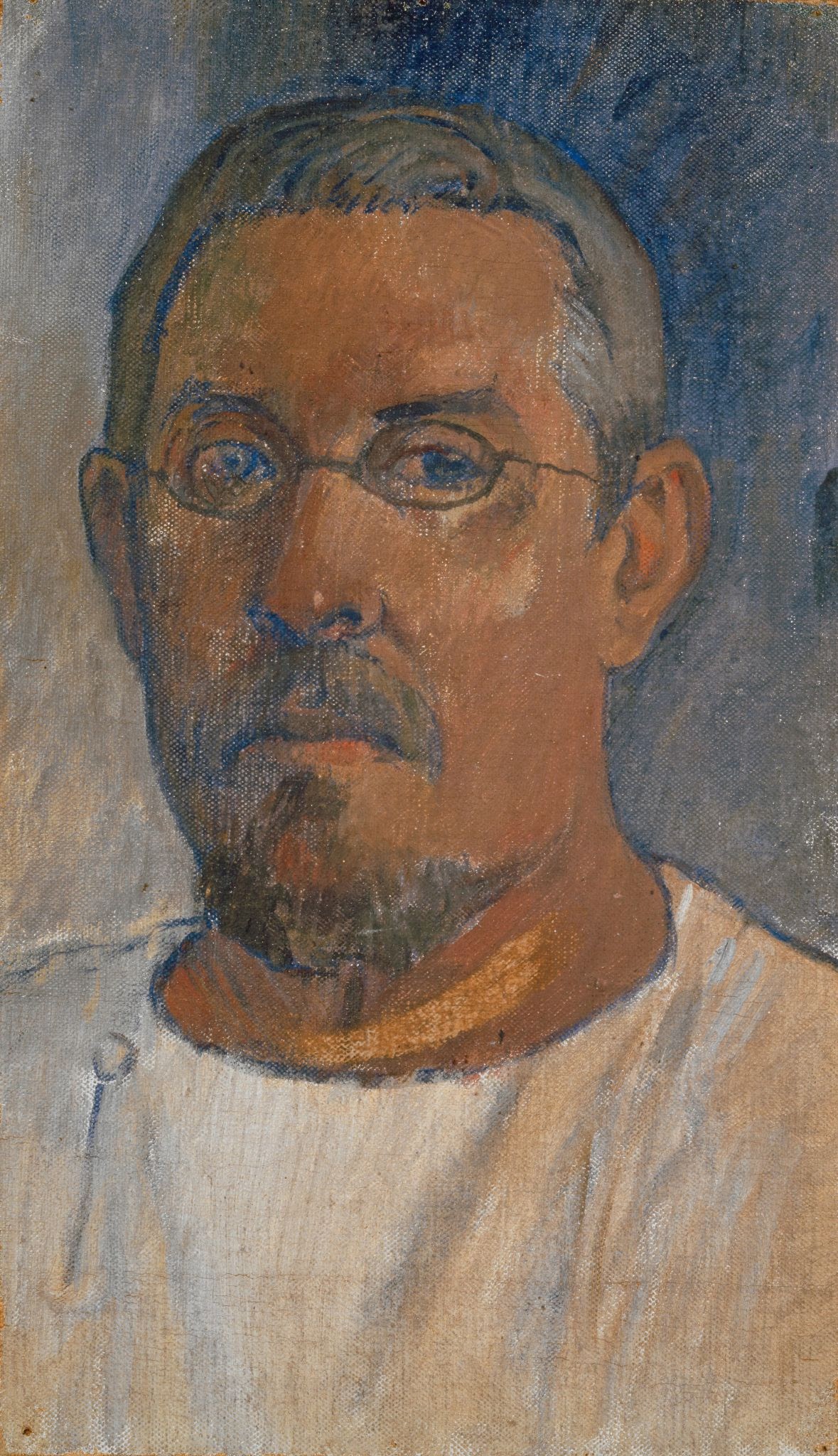
 Paul Gauguin (June 7, 1848 – May 8, 1903) was a foundational French Post-Impressionist painter whose bold use of color, flat planes, and Symbolist themes heavily
influenced modern 20th-century art, including Fauvism and Cubism.
Paul Gauguin (June 7, 1848 – May 8, 1903) was a foundational French Post-Impressionist painter whose bold use of color, flat planes, and Symbolist themes heavily
influenced modern 20th-century art, including Fauvism and Cubism.Queer Places:
Musée Gauguin, Hiva Oa 98741, French Polynesia
Cimetière d'Atuona, Atuona, Hiva Oa 98741, French Polynesia
Paul Gauguin (June 7, 1848 – May 8, 1903) was a foundational French Post-Impressionist painter whose bold use of color, flat planes, and Symbolist themes heavily
influenced modern 20th-century art, including Fauvism and Cubism.
Born in Paris, Gauguin spent his early childhood in Lima, Peru, which instilled a lifelong fascination with non-Western cultures. He served in the French merchant marine and navy before becoming a successful Paris stockbroker, marrying Mette-Sophie Gad, and fathering five children.
Following the Paris stock market crash of 1882, Gauguin abandoned financial trading to paint full-time. He studied alongside Camille Pissarro, participated in Impressionist exhibitions, and later led the Pont-Aven School in Brittany, developing Synthetism—a style characterized by bold outlines, flattened perspective, and expressive, non-naturalistic color.
Gauguin spent two intense months in 1888 living and working alongside Vincent van Gogh at the "Yellow House" in Arles. The collaboration was artistically fruitful but emotionally tumultuous, ending abruptly after Van Gogh severed part of his own ear.
Seeking escape from European civilization and materialist culture, Gauguin moved to French Polynesia (Tahiti from 1891–1893 and 1895–1901, then Hiva Oa in the Marquesas Islands until his death in 1903). While this period produced many of his most famous masterpieces, modern art historians critically examine his romanticized, exoticized, and colonialist representations of Indigenous people.
While Gauguin identified primarily as heterosexual in his personal relationships, art historians and queer theorists actively examine his work and writings for his fascination with gender ambiguity, homoeroticism, and non-binary cultural spaces:
In Tahitian culture, māhū are individuals who embody a traditional third-gender identity, traditionally assigned male at birth but fulfilling social and cultural roles associated with women.
In his autobiographical Tahitian travelogue Noa Noa, Gauguin wrote extensively about his fascination with a young Tahitian man named Jotefa. While traveling into the forest together to gather wood, Gauguin described experiencing an intense, ambiguous attraction, writing: "Was it a man? Was it a woman? It was a friend... In this boyish body, there was something subtly feminine."
Works such as Maruru (Offerings of Gratitude) and Exotic Tales depict figures with intentionally fluid or non-binary gender features, directly reflecting the impression māhū culture made on his understanding of gender binaries.
Gauguin was critical of rigid Western Victorian standards regarding sexuality and gender identity.
Throughout his Polynesian corpus, Gauguin deliberately rendered male and female figures with shared anatomical characteristics—broad shoulders, soft muscularity, and similar hairstyles—to challenge strict European dichotomies of male vs. female form.
Art historians frequently analyze paintings such as Where Do We Come From? What Are We? Where Are We Going? (1897) for their use of androgynous central figures that bridge traditional gender lines.
The partnership between Gauguin and Vincent van Gogh in 1888 remains a central subject of queer art theory. Scholars examine their cohabitation in Arles through the lens of late 19th-century homosocial bonding, intense emotional intimacy, and creative rivalry, noting how both artists explored vulnerable male portraiture during this shared period.
References:
 Dictionnaire historique des homosexuel.le.s célèbres Paperback – October 19, 2017 by Michel Larivière |
Other references:
Support this project
This website is a passion project researched, developed, and funded entirely by me. If you find the content valuable and would like to help support the ongoing research and hosting costs, any contribution is deeply appreciated.
Thank you for keeping this independent resource alive!
My books on Amazon: Elisa Rolle's books